
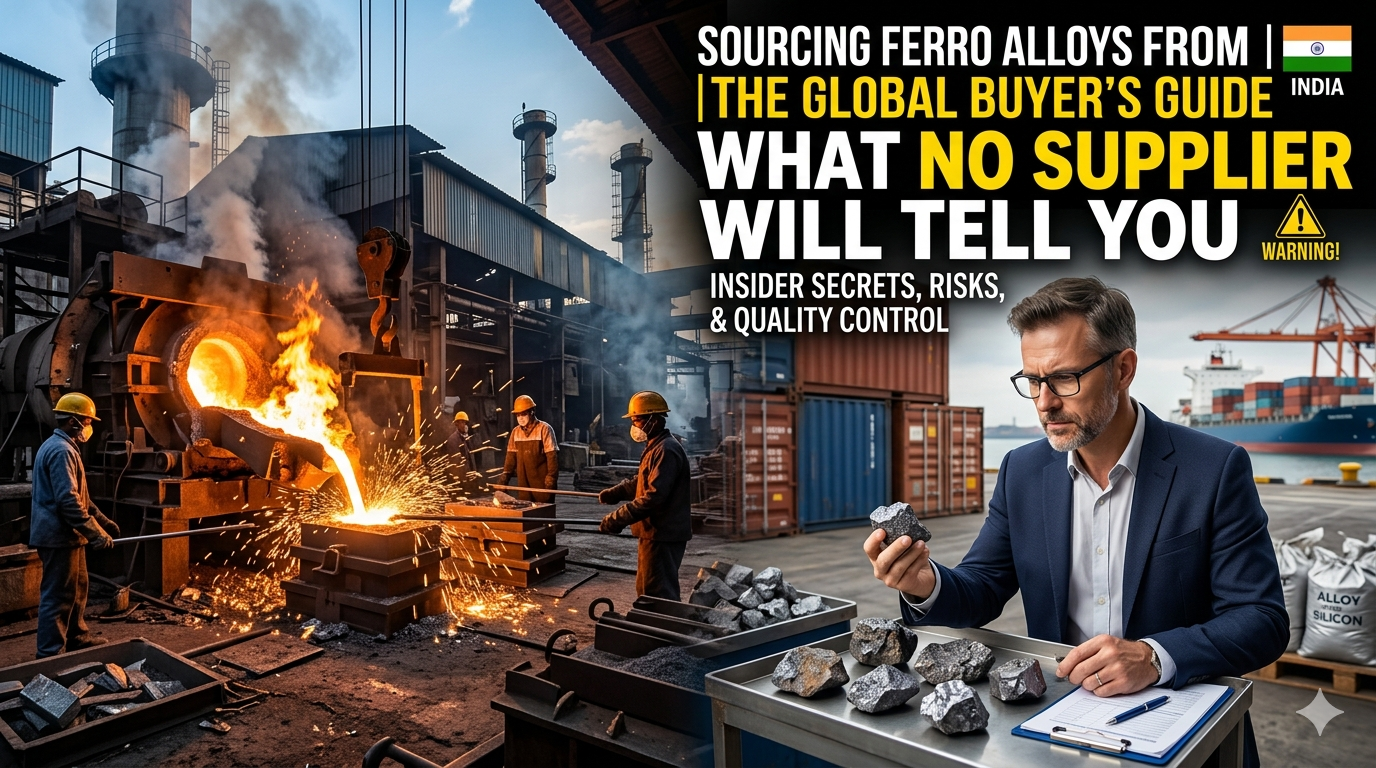
Every forging shop owner in Rajkot knows this moment. You place an order for ferro manganese through your regular trader, the material arrives, and three days into production, your quality team flags the batch. Manganese content is inconsistent. A downstream OEM is waiting. You eat the rejection cost — somewhere between ₹80,000 and ₹2 lakh — and call the trader to complain. He apologizes, gives you a small discount on the next order, and the cycle repeats.
What nobody tells you is that the trader himself is sourcing from a certified export house. You are paying his margin, his overhead, and his profit. The actual ferro alloy manufacturer or merchant exporter is sitting two layers behind your supply chain, selling to 60+ countries at globally competitive prices — and you, operating 200 kilometres away, are paying a 25–35% premium for the same material.
This is not a small problem. Across India’s 4,000+ forging units, 12,000+ foundries, and tens of thousands of casting and re-rolling shops, the middleman layer adds hundreds of crores to the industry’s raw material cost every single year. And almost nobody talks about it openly because the traders have built comfortable relationships with plant managers over decades.
This article is about breaking that cycle — understanding what ferro alloys actually are, why grade consistency matters more than price, and how direct sourcing from certified merchant exporters changes your cost structure permanently.
What Exactly Are Ferro Alloys and Why Should a Manufacturer Care?
Ferro alloys are master alloys — combinations of iron with one or more metallic elements like manganese, silicon, chromium, or phosphorus. They are added to molten steel or iron during the smelting and refining process to achieve specific metallurgical properties.
Here is a quick breakdown of the four most commonly used ferro alloys in Indian manufacturing:
Ferro Silicon Manganese (SiMn): Used as both a deoxidizer and an alloying agent. If you’re producing medium-carbon steel for forging applications — connecting rods, crankshafts, gear blanks — this is the alloy that determines your tensile strength and impact resistance. A variation of even 1–2% in silicon content changes your forging outcomes.
Ferro Manganese (FeMn): The primary hardness and wear resistance agent. Critical for auto parts that face cyclic stress. High carbon FeMn gives you strength; medium and low carbon grades give you ductility with hardness. Using the wrong grade here is one of the most common hidden causes of forging rejections in Indian SME shops.
Ferro Chrome (FeCr): If you’re producing stainless steel components, surgical tools, food processing equipment, or anything that needs corrosion resistance, you’re consuming ferro chrome. The difference between high-carbon and low-carbon FeCr affects your final product’s chromium content and, therefore, its corrosion resistance certification.
Ferro Silicon (FeSi): A deoxidizer and grain refiner. Critical in casting applications to prevent porosity. If your casting house is experiencing surface defects and internal voids that your team is attributing to mould quality, consider whether your FeSi grade and purity level is the actual culprit.
The point is this: ferro alloys are not a commodity where the cheapest price wins. They are precision inputs. Buying the wrong grade from a middleman who cannot provide mill test certificates is like buying an API for your software without documentation — things will break and you won’t know exactly why.
The Middleman Problem: How the Supply Chain Actually Works
Most Indian SME manufacturers are three or four steps removed from the actual source of their ferro alloys.
The chain typically looks like this: Certified Manufacturer / Merchant Export House → National Distributor → Regional Trader → Local Dealer → Your Factory.
Every node in that chain adds margin. Every node also adds uncertainty — because the material may be reblended, restocked, or mislabelled at each transfer point. By the time the material reaches your plant, the mill certificate (if it exists at all) is two or three transactions old and may no longer accurately represent what’s in your warehouse.
The solution is not complicated. It requires building a relationship directly with a certified merchant export house that:
- Has verifiable production or sourcing capacity
- Provides lot-specific mill test certificates with every delivery
- Operates under a quality management system (ISO 9001:2015 is the baseline)
- Is financially transparent — listed on a stock exchange like NSE is a strong indicator of compliance and governance
Companies like QVC Exports Ltd, a Kolkata-based NSE-listed merchant export house serving 400+ global clients across 60 countries, have structured their entire operation around bulk, grade-consistent supply. They supply the same material to steelmakers in Brazil, procurement teams in the UK, and foundries in the UAE at internationally benchmarked prices. There is no logical reason why an Indian manufacturer should pay more than an international buyer for the same material.
Grade Consistency: The Number That OEMs Actually Track
If you supply auto parts to a Tier-1 OEM, you already know that every rejection is logged, tracked, and eventually reflected in your vendor rating. What you may not realize is that a significant percentage of rejection root causes trace back to alloy inconsistency — not to your machining, heat treatment, or mould quality.
Here’s a practical example: A forging unit producing EN8 steel connecting rods needs a specific carbon and manganese range. If their ferro manganese supplier delivers batches with manganese content varying between 74% and 79% (a normal variation in low-grade ungraded FeMn from unverified sources), the final alloy composition shifts. The heat-treated parts may pass visual inspection but fail fatigue testing. The OEM rejects the batch. The forging unit blames the heat treatment team. The real culprit was the first purchasing decision made six months earlier.
This is why procurement from certified sources matters more than saving ₹2 per kilogram.
How to Transition from Trader-Dependence to Direct Sourcing
Transitioning to direct sourcing from a certified export house does not require a massive volume commitment in most cases. Here is a practical approach:
Step 1: Know your current consumption and grades. Pull your last 12 months of purchase orders. List every ferro alloy you buy, the grade specification, monthly quantity, and the price you’re paying. Most SME plant managers are surprised to discover they’ve never formally documented this.
Step 2: Request mill test certificates from your current supplier. Ask for the original mill certificate — not a photocopy of a photocopy. If your trader cannot produce a traceable, lot-specific certificate, that alone tells you something important about your supply chain.
Step 3: Research direct sources. Look for ISO-certified merchant export houses that publish their product range openly. Government-recognized export houses in India are registered and verifiable through DGFT (Directorate General of Foreign Trade). When researching suppliers online, many procurement managers use a temporary email address for initial B2B portal registrations to avoid their primary inbox getting flooded by dozens of traders — a useful practice when you’re in exploratory mode.
Step 4: Request a sample lot with full documentation. A serious supplier will provide material with a verifiable mill test certificate, packing list, and delivery schedule. Test it against your specification. If it passes, you have found a direct source.
Step 5: Negotiate volume-based pricing. Once you establish a direct relationship, your pricing will reflect actual market rates — not rates inflated by three levels of margin.
Building Your Manufacturing Brand While You’re At It
There’s a secondary opportunity hiding inside this conversation that most SME manufacturers overlook: the export market itself.
Indian forging, casting, and machined component manufacturers are increasingly competitive at the global level. Auto parts made in Rajkot, Ludhiana, and Pune are being shipped to Germany, the US, and Southeast Asia in growing volumes. But many SME units that could enter the export market hesitate because they don’t feel their brand is “ready.”
Here’s the reality: if you’re already meeting OEM quality standards domestically, you have what it takes. What often holds back smaller manufacturers is the lack of a strong company identity — a professional name, a logo, and a web presence that can hold its own against international competition.
This is where tools like Nameoor’s AI business name generator become genuinely useful. Before spending thousands on a brand consultant, running your company’s name and identity through an AI-powered naming and logo tool gives you a structured starting point — you can generate name options, check how they sound internationally, and build a basic brand identity without a six-month agency project.
The Bottom Line
The ferro alloy market in India has a structural inefficiency that costs manufacturers real money every quarter. The fix is not complex: move closer to the source, demand traceability, and make procurement decisions based on documented grade consistency — not just price per kilogram.
For SMEs planning to grow — whether domestically or into export markets — the same discipline that applies to raw material sourcing applies to brand building. Professionalism at every level of your operation is what separates manufacturers who scale from those who stay stuck in the trader-dependent cycle.
Your raw material decisions today determine your OEM relationships two years from now. Start there.