
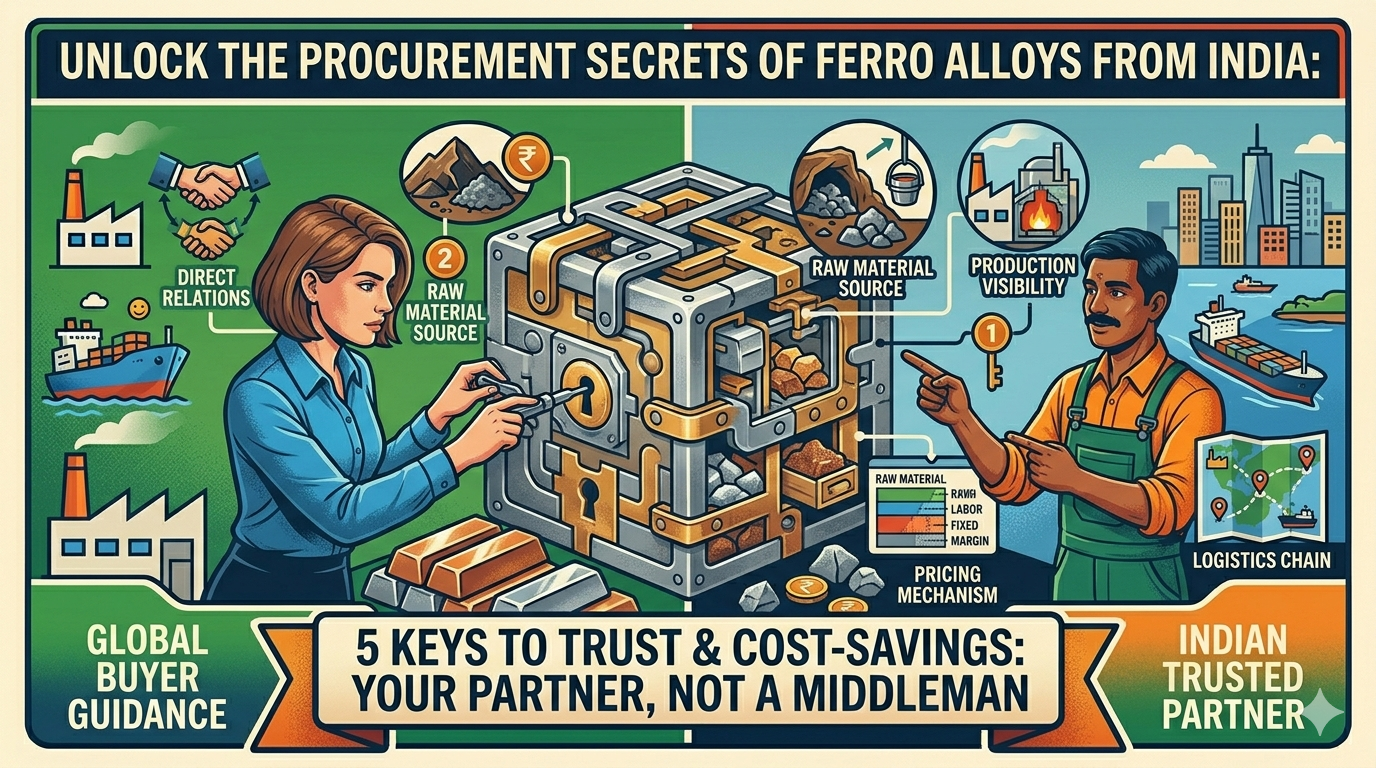
India exports ferro alloys to more than 80 countries. It is among the world’s top producers of ferro manganese, ferro chrome, and ferro silicon — materials that flow into steel mills, foundries, and specialty metal manufacturers from Brazil to Bangladesh, from the United Kingdom to South Korea. And yet, for every procurement manager who has successfully built a reliable Indian ferro alloy supply chain, three others tried and walked away frustrated.
Not because Indian suppliers are bad. But because the sourcing process itself is filled with information gaps, verification challenges, and a specific kind of supplier noise that obscures the genuinely strong manufacturers from the opportunistic ones.
This guide is written for international buyers — procurement leads, trading companies, and supply chain officers who need ferro alloys from India at scale, with consistency, documentation, and the kind of supplier relationship that survives audits and geopolitical freight disruptions. Here is what the process actually looks like when it works, and what most suppliers won’t tell you upfront.
Why India for Ferro Alloys? The Real Structural Advantage
Before the sourcing process, the rationale. International buyers often come to India for one reason — price — and then leave because they discovered that the price advantage came with quality variance and documentation gaps. This is a misunderstanding of what India’s actual competitive position is.
India’s ferro alloy advantage is not purely cost. It is a combination of factors that, taken together, make it genuinely difficult to replicate:
Raw material proximity. India’s iron ore reserves are among the largest in the world. Manganese ore deposits in Odisha and Maharashtra, chromite in Odisha, and quartz for silico manganese are all available domestically. This vertical proximity lowers input costs structurally — not because of cheap labour or currency depreciation, but because the supply chain is shorter.
Established manufacturing capacity. Clusters like Durgapur in West Bengal, Raipur in Chhattisgarh, and Visakhapatnam in Andhra Pradesh have been producing ferro alloys for decades. The metallurgical knowledge base is deep. Manufacturers running electric arc furnaces have process stability that comes from 20–30 years of continuous operation.
Regulatory framework. India’s export ecosystem is regulated through DGFT, and serious exporters operate with BIS certification, ISO quality management systems, and in some cases are listed on stock exchanges like NSE — providing financial transparency that is rare in purely privately-held commodity suppliers.
The sourcing challenge is not finding Indian ferro alloys. It is finding the right Indian ferro alloy supplier — one whose quality system, financial stability, and export documentation capabilities match international buyer requirements.
The Supplier Landscape: Understanding Who You’re Dealing With
When a procurement manager posts an RFQ on a B2B platform or reaches out to Indian ferro alloy suppliers, they typically receive responses from three very different kinds of entities — and all three present themselves similarly.
The Merchant Export House is a government-recognized category in India. These are companies that do not necessarily operate their own furnaces but source from certified manufacturers, conduct quality checks, handle all export documentation, and build long-term supply relationships. The best ones serve 300–500 global clients and are essentially specialized trading companies with deep metallurgical expertise and logistics infrastructure. They are often the most reliable partner for international buyers because their business model depends entirely on consistent delivery performance.
The Manufacturer-Exporter is a company with its own production facility that also handles export. The advantage is direct production control. The challenge is that not all manufacturers have the export documentation, logistics, and international commercial compliance infrastructure that large buyers require. Some do — and these can be exceptional partners. Others have the product but not the paperwork.
The Speculative Trader is a broker or intermediary presenting themselves as a supplier. They have no production capacity, no inventory, and no real quality control. They will confirm your order, source from whoever gives them the best margin that week, and deliver material with inconsistent specifications and generic or falsified certificates. This category is unfortunately common in India’s commodity export ecosystem, and distinguishing them from genuine suppliers requires deliberate verification.
The first step in any Indian ferro alloy sourcing exercise is determining which category your potential supplier falls into before you send a sample order.
Verification Protocols That Actually Work
Most international buyers rely on one of two verification approaches: asking for references, or requesting samples. Both are useful, but both are also easy to game. Here is a more robust verification framework.
Check stock exchange listing and financial filings. If a supplier claims to be a listed company, this is verifiable. NSE-listed companies like QVC Exports Ltd file quarterly financial reports, have board composition disclosures, and are subject to SEBI regulatory oversight. A publicly listed ferro alloy exporter is a meaningfully different risk profile than a private company with no external accountability.
Request lot-specific mill test certificates — not generic product certificates. A serious supplier will provide a mill test certificate specific to the production lot being offered, signed by a laboratory that is third-party accredited. Generic product specification sheets are not certificates. If the supplier offers only generic data sheets, that is a signal.
Verify DGFT registration and Merchant Export status. Government-recognized Merchant Export Houses in India are registered with the Directorate General of Foreign Trade. Their recognition can be confirmed. This is a 10-minute verification step that eliminates a significant portion of speculative traders.
Check ISO certification authenticity. ISO 9001:2015 certification is valuable only if it is current and issued by an accredited certification body. Certificate numbers can be verified directly with the issuing body. A certificate that cannot be verified is not a certificate.
Validate the company name and entity uniqueness before finalizing. This is a step that many procurement teams skip — and it creates problems later. In India’s export ecosystem, there are many companies with similar names, registered in different states, offering similar products. Before signing a commercial contract, it is worth checking how many businesses operate under a similar name. Using a similar business name checker can surface naming conflicts and help you confirm you’re dealing with the specific registered entity you researched — not a similarly-named competitor or a fraudulently-presented entity.
Managing the Inquiry Phase Without Destroying Your Inbox
This is a practical issue that almost no sourcing guide addresses directly: when you begin researching Indian ferro alloy suppliers, your business email address will be captured by B2B platforms, trade directories, and supplier databases — and within days you will receive unsolicited commercial communications from dozens of traders.
Experienced procurement teams handle this by using a dedicated inquiry channel separate from their primary business communication. Some teams create a department-level procurement inbox. Others, particularly when in exploratory sourcing phases, use disposable email services for initial registrations on B2B platforms — maintaining a clean primary inbox while they evaluate the supplier landscape, before transitioning verified shortlisted suppliers to formal business communication channels.
The point is not to be evasive. It is to structure the information flow so that your evaluation process is controlled, not reactive.
Incoterms, Packing, and Port Selection: Where Indian Sourcing Gets Complicated
Once you have identified a verified supplier, the commercial structure of the transaction requires attention to details that differ from sourcing in Europe or North America.
Incoterms selection matters more with ferro alloys than with many other commodities because of the density and packing complexity of the material. FOB (Free on Board) from an Indian port places the freight and insurance risk on the buyer from the point of loading. CIF (Cost, Insurance, Freight) and CFR (Cost and Freight) shift that responsibility to the seller. For first-time buyers from India, CIF or CFR typically reduces logistical complexity — you receive the material at your destination port with all international freight handled by a supplier who knows Indian port operations.
Packing options for ferro alloys typically include 1MT jumbo bags, 50kg bags packed inside 1MT big bags, bulk in containers, or palletized big bags. The right choice depends on your handling equipment, storage conditions, and downstream unpacking infrastructure. A supplier who asks about your destination port and unloading capabilities before recommending packing is a supplier who knows what they are doing.
Port selection from India is largely driven by production location. Ferro alloys produced in West Bengal typically ship from Kolkata or Haldia port. Material from Odisha and eastern India also frequently routes through Kolkata. Understanding this geography helps you anticipate transit times and loading lead times — important for production scheduling at your end.
What a Strong Long-Term Supply Relationship Looks Like
The best Indian ferro alloy suppliers think in years, not transactions. They will allocate production or inventory capacity for reliable buyers, offer grade customization within their capability, and proactively communicate when raw material inputs or freight conditions will affect pricing or lead times.
The signals of a supplier capable of a long-term relationship are not difficult to read. They respond to technical queries with specific answers, not marketing language. They provide traceability documentation without being asked twice. They have references from clients in multiple geographies who have been sourcing from them for five or more years.
QVC Exports Ltd, for example, serves 400+ industrial clients across 60+ countries and has done so for more than 30 years. That kind of operational continuity is not accidental. It reflects process stability, quality discipline, and the kind of export infrastructure that international buyers actually need — not just the ability to fill one sample order, but the ability to be a reliable partner across market cycles and freight disruptions.
Final Checklist for International Buyers
Before committing to an Indian ferro alloy supplier, run through this:
- Is the supplier government-recognized (Merchant Export House or manufacturer-exporter with verifiable credentials)?
- Is the company listed on a stock exchange or independently auditable?
- Does their ISO certification align with the issuing body?
- Can they provide lot-specific mill test certificates?
- Have you validated their entity name against similarly-named companies?
- Is their proposed incoterm, packing, and port selection appropriate for your logistics setup?
- Do they have verifiable references from buyers in your region or industry?
If the answer to these questions is yes, you have likely found a supplier worth pursuing seriously. The ferro alloy market in India is deep and competitive. The work is in the selection, not the supply.