
Most procurement managers in the steel industry can name their preferred grades of ferromanganese or specify a silicon content range without blinking. But ask them to explain why their current supplier relationship works — or more often, why it doesn’t — and the answers get complicated fast. Sourcing ferro alloys at scale is one of those business functions where the technical knowledge is rarely the problem. The challenge is everything around it: lead times, purity consistency, regulatory compliance, geopolitical exposure, and the slow erosion of trust that happens when a supplier treats your order as a transaction rather than a partnership.
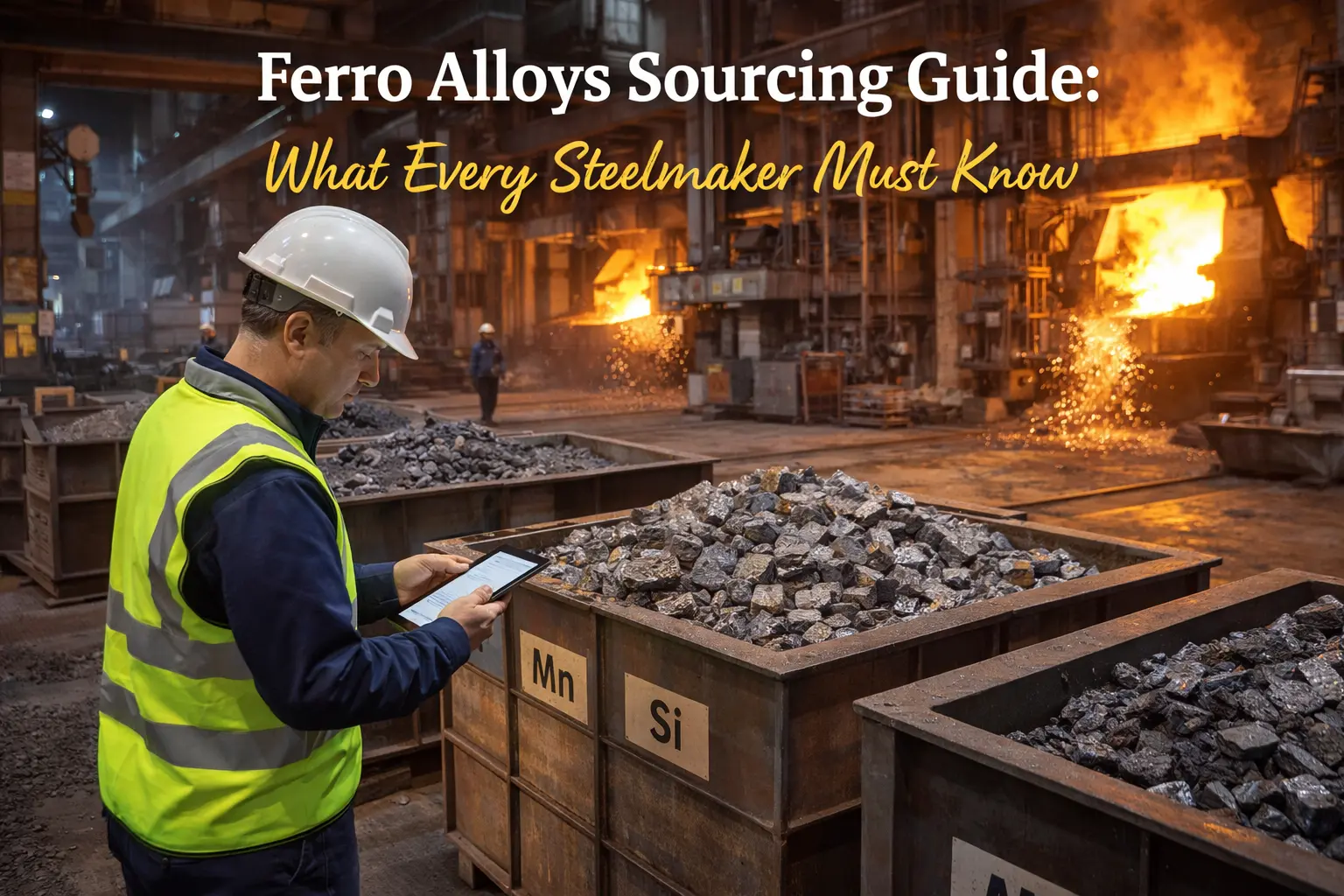
This guide is for procurement teams, metallurgical managers, and industrial buyers who want to think more clearly about where their ferro alloys come from, how to evaluate suppliers properly, and what the global market shift toward sustainability and compliance actually means for their sourcing strategy. It’s also a guide for steelmakers and foundries who are still running on legacy supplier relationships and haven’t seriously revisited them in years. That moment is overdue.
Why Ferro Alloys Are More Strategically Critical Than Most Buyers Treat Them
Ferroalloys are iron alloys containing other elements used to improve the characteristics of iron for certain uses, and they are critical in steel manufacturing, foundries, and metallurgy industries. They give the base metal desirable properties such as improved strength, corrosion resistance, and heat resistance. Every major steel grade in commercial production — from structural carbon steel to corrosion-resistant stainless — depends on precise alloy additions during the melting and refining stages. Get the alloy chemistry wrong, or receive an inconsistent batch, and the entire heat is compromised.
Despite this, ferro alloys are consistently underprioritized in sourcing strategy. Many buyers treat them the same way they treat commodity consumables — something to be purchased at the lowest available price from whoever has stock. This approach works until it doesn’t, and when it fails, it fails at the worst possible moment: mid-production, with furnaces running and a delivery deadline already in the schedule.
The global ferroalloys market value stood at US$50.06 billion in 2023 and is expected to reach US$71.05 billion by 2029, growing at a CAGR of 6.01% over the projected period of 2024–2029. That growth is being driven by expanding infrastructure investment, automotive manufacturing, renewable energy construction, and the global push for high-performance steel in increasingly demanding applications. The companies best positioned to benefit from that demand are those who’ve built reliable, compliant, long-term sourcing relationships — not those chasing the cheapest spot price on any given quarter.
The Four Core Ferro Alloys and What They Actually Do
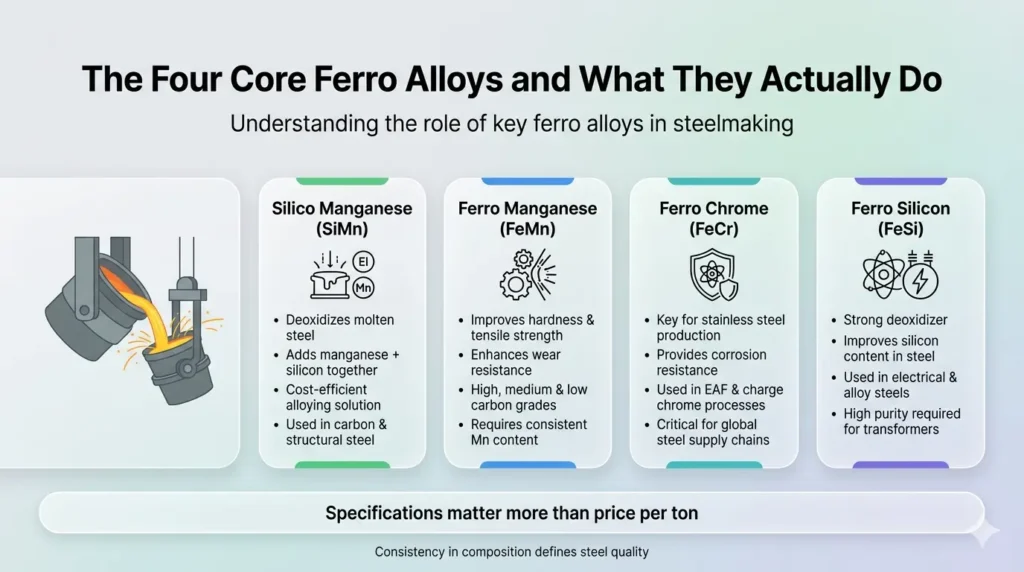
Before evaluating any supplier, buyers need to be precise about what they’re sourcing and why. The four major ferro alloys — silico manganese, ferro manganese, ferro chrome, and ferro silicon — serve distinct functions in steelmaking, and their specifications matter far more than their price per metric ton.
Ferro Silico Manganese (SiMn)
Silico manganese is a composite ferroalloy that performs two functions simultaneously: it deoxidizes the molten steel bath and adds manganese as an alloying element. Because it delivers both silicon and manganese in a single addition, it’s more cost-efficient than adding the two elements separately. It’s used extensively in the production of carbon steel, structural steel, and various alloy steel grades.
The critical specifications to nail down are manganese content (typically 60–68%), silicon content (14–20%), and carbon levels, which must remain controlled to avoid unintended hardening. Phosphorus and sulfur impurities are also closely watched, as these create brittleness and weld quality issues in downstream fabrication.
Ferro Manganese (FeMn)
Ferro manganese is used to enhance hardness, tensile strength, and wear resistance. High-carbon ferro manganese (70–80% Mn, >2% C) is used in most standard steel grades. Medium- and low-carbon grades are specified for applications where carbon content must be tightly managed — particularly in pipeline steel, automotive grades, and high-strength structural applications.
The key procurement consideration for ferromanganese is manganese content consistency batch to batch. A supplier who delivers 74% on one shipment and 71% on the next creates real metallurgical problems. Consistent grade control is not a preference — it’s a hard requirement.
Ferro Chrome (FeCr)
Ferro chrome is the primary raw material for stainless steel production. Ferro Chrome is a key ingredient in stainless steel production, contributing to its corrosion resistance and aesthetic appeal. High-grade ferro chrome products sourced from trusted sources meet the stringent requirements of stainless steel manufacturers worldwide. Without a reliable chromium source, stainless steel production grinds to a halt. Given that stainless steel demand is growing globally — in food processing equipment, medical devices, chemical plants, and construction — ferro chrome is one of the more strategically sensitive materials in any mill’s raw material portfolio.
Charge chrome (for electric arc furnace production of stainless steel) and high-carbon ferro chrome have different specification profiles. Buyers should be explicit about which grade is required and verify that their supplier’s production process is actually calibrated to deliver it consistently.
Ferro Silicon (FeSi)
Ferro silicon is a powerful deoxidizer and is also used to improve the silicon content of electrical steel and silicon-alloyed structural grades. Deoxidizer was the largest application segment for ferro silicon, accounting for more than 78.95% of overall revenue. High-purity ferro silicon — with controlled sulfur and phosphorus levels — is essential for electrical steel used in transformer cores and motor laminations, where magnetic permeability is critical.
For most general steel applications, 75% FeSi is the standard grade. For specialty applications, 90% grades may be specified. The purity requirements for electrical steel are particularly demanding, and suppliers who can consistently meet them are genuinely rare.
Why India Has Become the Preferred Sourcing Hub
Asia-Pacific holds a dominant 68.7% share of global ferro alloy production and consumption. Within that region, India has carved out a specific position that goes beyond volume. India ranks among the top global producers of silico manganese and high-carbon ferro manganese, and its industrial base has invested seriously in quality certifications, export compliance, and logistics infrastructure over the past decade.
India has substantial reserves of manganese ore and other inputs essential to ferro alloy production. Many production units are located close to ports or connected through dedicated freight corridors, allowing Indian manufacturers to deliver on time, with fewer bottlenecks and better traceability.
What this means practically for global buyers is that Indian ferro alloy exporters can often deliver more competitive pricing than European producers while maintaining quality standards comparable to them. The combination of domestic raw material access, skilled technical workforces, and port connectivity through hubs like Visakhapatnam, Kandla, and Kolkata creates a supply chain that works.
The government-recognized Merchant Export House framework in India adds another layer of credibility to established exporters. Companies operating under this designation have been evaluated by Indian trade authorities and carry government-backed credentials that matter in international procurement due diligence. Combined with certifications like ISO 9001:2015, AEO (Authorized Economic Operator) status, and ISO 45001:2018 for occupational health and safety, these credentials tell a buyer that the supplier has been stress-tested by frameworks beyond their own marketing claims.
What a Reliable Ferro Alloy Supplier Actually Looks Like
The procurement industry has no shortage of companies willing to send a price list. Identifying a supplier who will actually perform — through volatile markets, logistical disruptions, and changing grade requirements — takes a different kind of evaluation.
Certifications Are a Floor, Not a Ceiling
ISO 9001:2015 is the baseline. Any serious ferro alloy exporter should have it, and if they don’t, the conversation should end there. But certifications alone don’t mean much without understanding what they cover. Ask to see quality control documentation from recent shipments. Ask about their internal testing laboratory and what analytical methods they use to verify alloy chemistry. Ask about batch traceability — if a quality issue emerges six weeks after delivery, can they trace that batch back to its production date, furnace run, and raw material inputs? The answer to that question tells you more about a supplier’s reliability than any certificate.
Consistency Over Spot Pricing
Over 62.5% of producers report challenges from volatile raw material prices and inconsistent supply chain logistics. The suppliers who absorb that volatility rather than passing it directly to buyers are the ones worth holding onto. A supplier with long-term raw material contracts, diversified sourcing, and financial stability can maintain price and delivery commitments even when manganese ore prices spike or freight rates shift. A spot-market-dependent supplier will push every disruption downstream to you.
This is why the cheapest price on a given tender is often not the lowest total cost. Factor in re-testing costs, production delays from off-spec material, and the administrative burden of managing inconsistent suppliers, and the math changes significantly.
Technical Depth and Pre-Sales Support
Good ferro alloy suppliers can engage with your metallurgical team. They know what silicon residual levels your electric arc furnace can tolerate. They know the difference between what a structural steel grade needs versus a high-tensile automotive grade. If your supplier contact can only talk about prices and delivery dates, you’re being serviced by a trading desk, not a metallurgical partner.
Before signing any long-term supply agreement, ask your prospective supplier for sample material and independent third-party lab testing. Reputable exporters expect this request and welcome it. Those who push back or offer only their own internal test certificates without supporting a third-party verification should raise a flag.
Geographic and Logistics Capability
Tailored solutions serving steel mills across Southeast Asia, the Middle East, Europe, Africa, and Latin America — this kind of geographic breadth matters because it indicates a supplier has navigated diverse regulatory environments, customs frameworks, and incoterm structures. A supplier who only ships to one region has fewer operational challenges to manage. A supplier shipping to five continents has already solved the logistics puzzles that will inevitably arise in your supply relationship.
Understand the incoterms your supplier works with (FOB, CIF, CFR), what packing options they support, and whether they have experience with your destination port. Delays caused by incorrect documentation or unfamiliar customs requirements at the destination are more common than they should be, and a supplier with genuine global experience eliminates most of them.
The Compliance Landscape Is Changing — And It Affects Your Sourcing
The most significant shift in global ferro alloy procurement over the next decade won’t be a price move. It’ll be regulatory. Regulations such as the Carbon Border Adjustment Mechanism (CBAM) now require exporters to monitor, minimise, and transparently report their carbon emissions. For European buyers in particular, CBAM means that by 2026, every tonne of ferro alloy imported must come with documented carbon content reporting. Suppliers who can’t produce this data will simply lose access to European markets.
This has immediate implications for procurement strategy. Buyers sourcing for European steel mills should already be requiring carbon emission documentation from their ferro alloy suppliers. Those who haven’t started this conversation are behind. A 56.3% increase in demand for low-carbon ferro alloys due to stricter environmental regulations globally is already reshaping which suppliers are preferred and which are being phased out of European supply chains.
Beyond CBAM, the general compliance burden in international trade has grown considerably. AEO (Authorized Economic Operator) certification — which applies to both exporters and importers in many jurisdictions — streamlines customs procedures and reduces the risk of shipments being held at borders. Suppliers operating at AEO Tier 2 level have been audited on their internal control systems, security measures, and financial solvency. For buyers, this means lower logistical risk at the customs stage.
A practical note that’s relevant here for any industrial company managing procurement relationships digitally: if your organization runs a web portal for supplier registrations, buyer inquiries, or order management — and you’re collecting business contact information, company data, or financial details through it — most jurisdictions now require a compliant data handling disclosure to be in place. This applies in Europe under GDPR, in the US under various state frameworks, and in a growing list of markets in Asia and the Middle East. Getting that documentation in order takes considerably less time than most legal teams anticipate, and having it sorted before a major buyer or auditor asks to see it is simply good practice.
How to Structure a Long-Term Supply Agreement
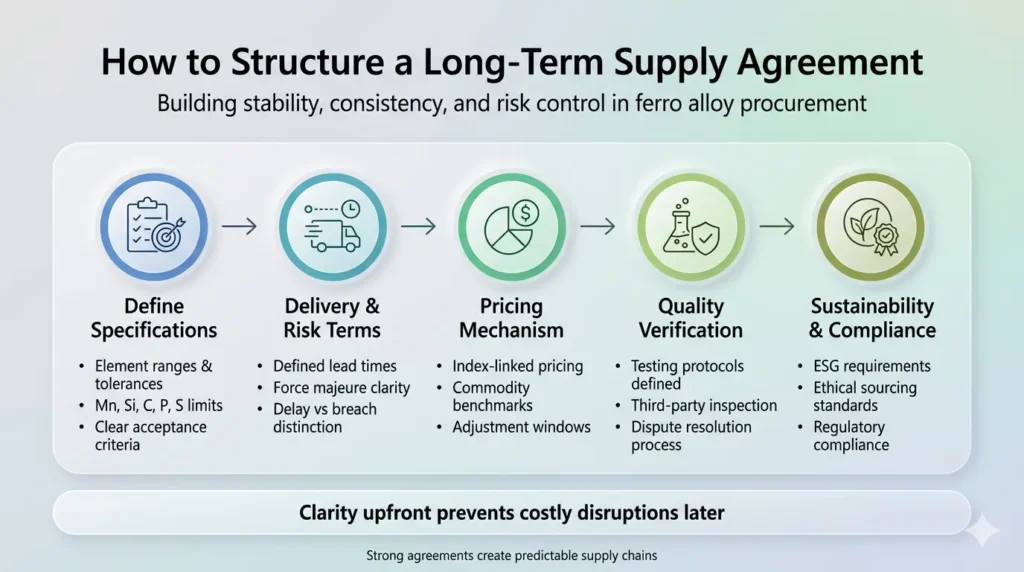
One-off spot purchases have a place in ferro alloy procurement — particularly for grades you need infrequently or in small volumes. But for any alloy that enters your production process on a regular basis, a properly structured long-term supply agreement protects both parties and creates the operational stability that procurement managers and production planners both need.
A well-structured supply agreement should cover several areas that buyers often leave vague:
Grade specifications and tolerances: Define exactly what you’re buying — not just the alloy name, but the minimum and maximum ranges for every element that matters to your process. Include provisions for what happens when material falls outside tolerance: rejection, replacement, credit, or re-grade.
Delivery timelines and force majeure: Define lead times explicitly. Specify what constitutes acceptable force majeure versus what counts as a breach. Port delays caused by weather are different from production failures caused by maintenance issues, and your agreement should treat them differently.
Pricing mechanisms: For long-term agreements, pure fixed pricing rarely works because raw material costs genuinely fluctuate. Consider index-linked pricing mechanisms that track manganese ore or chromium prices at recognized benchmarks, with defined adjustment windows. This gives both parties predictability without asking the supplier to absorb every commodity swing.
Quality verification: Define the testing protocol — who tests, at which stage, using which methods, and what the dispute resolution process is if your results and the supplier’s results differ. Independent third-party testing at origin for large shipments is standard practice among sophisticated buyers.
Sustainability and compliance requirements: As CBAM and similar regulations take effect, build carbon documentation requirements into the agreement now. Ask for ISO 45001 compliance and CSR reporting as part of the supplier’s ongoing obligations. Suppliers who already hold these certifications won’t resist these clauses.
Evaluating Your Existing Supply Chain: Questions Worth Asking Right Now
Most procurement teams running established ferro alloy supply relationships haven’t done a systematic review in years. The market has changed enough — on compliance, sustainability, and digital transparency — that a review is overdue. Here are the questions worth working through:
When did you last independently test a shipment from your current supplier against their certificate of analysis? If the answer is “never” or “years ago,” you’re operating on trust that may not be warranted.
Can your current supplier provide CBAM-compliant carbon emission documentation for their production process? If European regulations affect any of your customers downstream, your own supply chain exposure to this question is real.
What is your current supplier’s AEO status, and what does that mean for your customs clearance timelines at your destination ports?
How many suppliers does your current ferro alloy sourcing depend on? Single-source dependency in a market as subject to geopolitical and logistical disruption as raw material supply is a strategic risk that’s easy to underestimate until a disruption happens.
Has your supplier had documented quality incidents with other customers in the past two years? Asking for references from similarly-sized buyers in similar industries is not unusual in B2B procurement, and suppliers with clean track records will give you them without hesitation.
The Steel Industry’s Green Transition and What It Means for Ferro Alloy Sourcing
In the forthcoming years, the ferroalloys market is expected to continue growing due to emerging trends in green steel production and eco-friendly manufacturing practices. As countries adopt stricter environmental regulations, especially in Europe and North America, the ferroalloy industry is adapting by implementing cleaner production technologies, including the use of renewable energy sources and recycling methods.
This transition matters for ferro alloy buyers in two specific ways. First, green steel production — particularly steel made via hydrogen direct reduction or electric arc furnace routes powered by renewable energy — has different alloy requirements than conventional blast furnace steel. The chemistry of the process affects which alloys are used and at what stage. Procurement teams at mills transitioning toward greener production routes need to be actively discussing these changes with their alloy suppliers now, not after the transition is made.
Second, the environmental credentials of your alloy supplier increasingly matter to your own ESG reporting and customer disclosure obligations. If your downstream customers — automotive OEMs, construction firms, appliance manufacturers — are tracking Scope 3 emissions through their supply chains, the carbon footprint of your ferro alloys flows directly into their calculations. Suppliers who can provide verified emissions data and who operate under certified environmental management systems (ISO 14001 or equivalent) become more valuable as this transparency expectation rises.
By embracing advanced technologies, embedding sustainability principles, and strengthening supply chain integration, the most competitive ferro alloy exporters are successfully converting global challenges into long-term strategic opportunities. The ones who aren’t making these investments are becoming gradually less attractive to the buyers who will define the steel industry’s next decade.
What Good Looks Like: The Criteria for a Best-in-Class Ferro Alloy Supplier
Pulling together everything covered in this guide, the profile of a genuinely excellent ferro alloy supplier looks like this:
They hold ISO 9001:2015 and have additional certifications relevant to their market — AEO status, ISO 45001:2018, and documented CBAM compliance for suppliers serving European customers.
They have a track record of at least 25–30 years of consistent export activity across multiple geographies and can provide verifiable references from buyers comparable to your operation.
They have an in-house laboratory and offer third-party verification on request. Their certificate of analysis matches independent test results, consistently.
They communicate clearly on pricing, with transparent mechanisms for adjusting to raw material market movements rather than surprise invoice adjustments.
They’ve invested in logistics infrastructure — in the case of Indian exporters, this means port connections, reliable freight forwarder relationships, and experience with the customs frameworks of your destination country.
They engage technically. Their representatives can speak your metallurgical language, understand your process requirements, and flag potential issues before they become problems in your furnace.
And critically: they treat your business as a long-term relationship rather than a one-time transaction. The suppliers worth working with are those who ask what your production schedule looks like six months from now, not just what you need next shipment.
Closing Thought
The ferro alloy sourcing decisions your procurement team makes this year will shape your production quality, your regulatory compliance exposure, and your cost structure for the next several years. The market is growing — from USD 61.90 billion in 2025 to USD 115.42 billion by 2033 — and the most capable suppliers are building the capacity and compliance infrastructure to service that growth. The question for every steelmaker and foundry is whether their current supplier relationships are keeping pace.
Doing the evaluation seriously, asking the hard questions, and being willing to move volume to suppliers who’ve earned it through demonstrated quality and compliance — that’s what procurement maturity looks like in this industry. The companies who get that right build a supply chain that holds up not just when markets are calm, but when they’re not.